
The optimistic case for a positionless little guy
Jordan Smith Jr. likens himself to Kawhi Leonard, who is six inches taller than him. Should we believe him? And if so, is that a good thing?

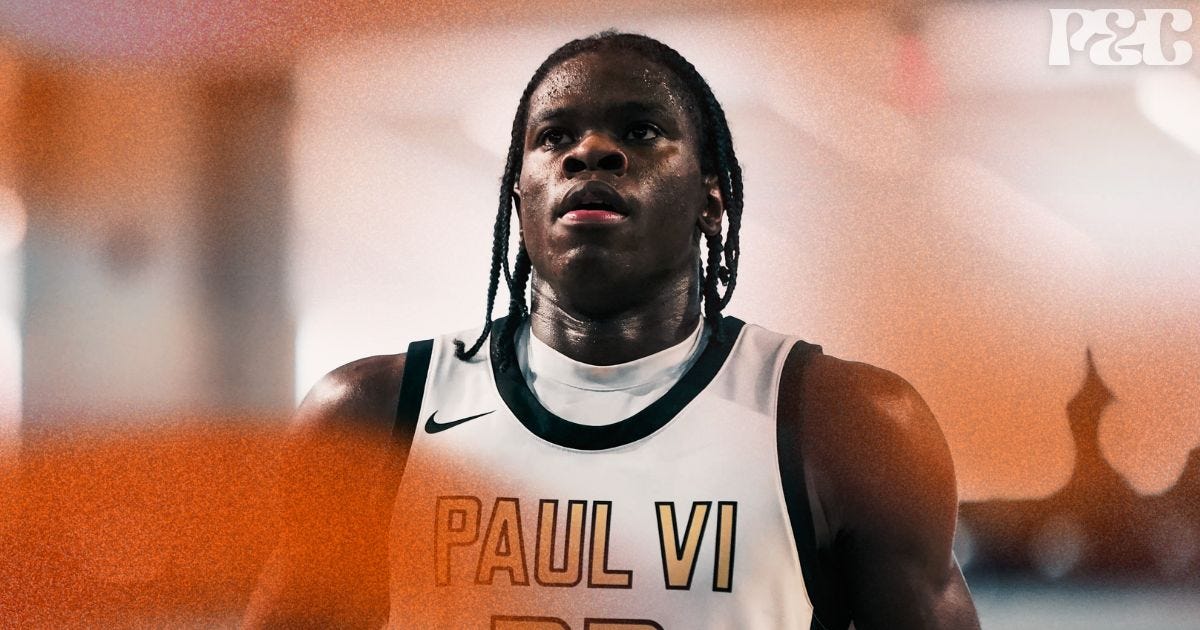
Welcome back to Prospects & Concepts, the only NBA Draft blog that thinks positionless basketball should include bulldog-y little guys.
Jordan Smith Jr. is the poster child for this.
He stands just 6 feet 1 inch, and that’s been the case for years. He’s not growing any time soon. Smith is physically imposing for that size, though. He’s a cut-up 205 pounds, with a high-shouldered 6-foot-9 wingspan. He may measure closer to 6-foot-flat without shoes, meaning that’s a plus-9-inch wingspan – tied for the fifth-longest wingspan differential in NBA history.
You know who else has a plus-9-inch wingspan? Kawhi Leonard, someone Smith has compared himself to.
“I feel like my player comparison, people have told me... it's Kawhi, just because of how we attack the best player offensively. And we keep it as simple as possible.”
It’s a noteworthy enough comparison to at least dig into.
Smith truly is built like Leonard, just a half-foot shorter. He’s dominant on defense, as one of the best on that end in the 2026 high-school class. He’s been a shoo-in for three stocks per game, aside from FIBA competitions where he’s consistently played up in age – averaging 2.9 stocks in 15 minutes per game in 2024 with the U17 squad, and 2.7 in 18 minutes per game in 2025 with the U19 squad.
Defensive playmaking, especially relative to size, isn’t just a marker of superior defensive instincts; it’s an indication of all-around cognition. My most popular piece to date discusses this thoroughly, through the lens of a historic stock-man in Allen Graves.
REQUIRED READING: “What ‘stocks’ do and don’t mean”
Smith’s assist numbers aren’t going to blow anyone away. Passing is one of the thresholds he’s underwhelmed in, and why he’s far from the consensus top prospect in this class, along with traditional size.
However, not only does Smith’s defensive playmaking allude to there being more than meets the eye with his passing, it indicates his listed height means little.
One things stocks also do is translate. Whether from high school to college, Division II to Division I, mid-major to high-major, or NCAA to NBA, they tend to be “sticky” numbers.
Smith will undoubtedly be one of the premier non-center defenders in college basketball, in large part due to his defensive playmaking.
The plays below are not indicative of someone who is too small – not in the slightest – especially playing two years up in age. Smith’s functional size is that of a 6-foot-7 wing, or bigger, making him one of the more “positionless” small guards I’ve seen.
The plays above show athleticism, cognition and decisive aggression to the highest degree. Smith’s ability to make these plays doesn’t just aid defense, but it leads to more effective, fast-paced offensive opportunities.
He’ll often leak out after a play, where he’s consistently been incredible.
Smith dunks easy for his size, with 55 in 31 high school games this past year. For reference, that would rank 22nd in the NCAA this past year, over some truly massive individuals – including Morez Johnson Jr., Koa Peat and Trevon Brazile, all forward-sized high-flyers.
Many of those dunks were in transition, but Smith still logged 11 jams in the half court; more than double the half court total for any guard drafted in the 2026 draft lottery.
It is easier to dunk in high school, I’m not going to ignore that. However, Smith is one of the more functional athletes of any guard-sized player I’ve scouted. When he dunks, it can look like a wing, slashing to the rim for one-handed posters. Sometimes it’s even Shaq-like, with post-entries into drop steps for two-handed rim rockers.
It’s Smith’s uniquely, beyond-functional athleticism that makes him positionless.
He blocks shots, is omni-present in passing lanes, rebounds with gusto and dunks with ferocity. Those aren’t things you start the list with when looking for traits in a point guard.
Smith can play that position – it’s where he’ll likely start in Arkansas, especially given their depth of more traditional wings (two other highly-recruited freshmen among the bunch) – but long term, he may find himself elsewhere in the lineup.
There just isn’t precedent for that type of player in the league. In the Bart Torvik database, there’s only been six first-round picks to hit the following bench marks. All of whom have had successful NBA careers.
Height ≤ 77 inches
DREB rate ≥ 12.0%
STL rate ≥ 3.0%
BLK rate ≥ 2.0%
Dunks ≥ 10
Smith projects to be the highest-drafted of this bunch, as well as the shortest among them.
Another thing about all these players is the majority figured out how to shoot it well throughout their career. Why? Athletic playmaking and superb processing just gets you on the court.


REQUIRED READING: “Reviewing the 2004 NBA Draft” by 100guaranteed
It doesn’t always amount to shooting, but in the modern NBA, it usually does. While these guys figure out the margins between their superior athletic traits, they’re asked to fill the corners, and thus, become better by repetition.
Though two legs above the query aren’t included in the one above it, Smith likely fills in just as well. His passing, as mentioned, isn’t great for a point guard, but for a wing, it’s exceptional. His offensive rebounding also stacks up.
Smith’s jump shot isn’t anything worthy of adoration right now. In his senior season of high school, 33.6% on a four 3-point attempts per game, making up 31 percent of his shot diet. It also comes with a high-volume, yet underwhelming conversion rate at the line. Smith shot 73.6% on 8.4 free-throws per game.
It’s not much, but it’s reason for optimism. Shooting, in general, is something I see as an overrated swing skill, especially for athletes like Smith, but it’s something those players consistently develop.
So, what are we looking at with Smith? A point guard is not out of the question. He’s consistently been great in the turnover economy, with an assist-to-turnover ratio above two-to-one, but may lack the elite handling and processing necessary for full-time duties.
Is it a wing? At 6 foot 1 inch, it’s unlikely – we’ve never really seen anything like that at that much of a height disadvantage, though, the athletic traits are there.
Until we know for sure, I’m fine with keeping it at this: Jordan Smith Jr. is positionless, and he’s really, really good.
Prospects & Concepts is a reader-funded newsletter ran solely by myself, Logan Adams, a soon-to-be college graduate looking to break into the sports journalism world. Help support my dream by subscribing for just $5/month or $50/year.
As a subscriber, you’ll receive access to:
Any and all current, past and future content that is or may be behind a paywall.
Ability to comment on every post.
Access to the subscriber-only chat.
Ability to gift subscriptions to friends, family, etc.
And so much more!
Use the link below to subscribe and support Prospects & Concepts today!